What Is Really Going On in Arknights Endfield? (Full Lore Breakdown)
Arknights Endfield does not shout its story at you. It lets it sit in the background, unfolding through environments, dialogue fragments, and quiet implications. That approach will feel familiar to anyone who enjoyed the original Arknights, but Endfield shifts the tone in subtle ways. The result is a world that feels less like a stage and more like a place you are intruding on.
For players who care about narrative context and long term world building, this side of Endfield is worth paying attention to. It informs design decisions, shapes factions, and hints strongly at where the game is heading.
The Endfield setting and why it feels different
Endfield takes place on Talos II, a frontier world defined by instability. Not just environmental instability, but social and political instability as well.
This is not a heroic fantasy setup. You are not saving the world. You are managing collapse, exploitation, and survival. Corporations, local powers, and scattered communities all operate with competing priorities.
That tone matters. It explains why progression feels grounded. Why systems feel constrained. Why solutions are often imperfect.
Endfield’s world is built around compromise, not victory.
The Endministrator as a narrative role
Unlike many RPG protagonists, the Endministrator is not a traditional hero.
You are closer to a coordinator. A problem solver. Someone balancing risk rather than chasing glory.
This framing aligns perfectly with the gameplay. Base building, logistics, and team management are not just mechanics. They are narrative expressions of your role.
You are not meant to dominate Talos II. You are meant to keep things running.
That perspective gives weight to even small decisions.
Factions and quiet conflict
Endfield’s factions are not cleanly defined as good or bad.
Each group operates under pressure. Resources are limited. Authority is fragile. Cooperation often masks self interest.
What makes this compelling is restraint. The game avoids long exposition dumps. Instead, faction identity emerges through contracts, dialogue tone, and environmental details.
You learn who holds power by who controls infrastructure, not by who gives speeches.
This approach rewards players who pay attention rather than those who rush dialogue.
How lore supports gameplay systems
One of Endfield’s strengths is how lore and mechanics reinforce each other.
Resource scarcity is not just a balance choice. It reflects the instability of the region. Base building is not optional because infrastructure is survival.
Even combat design ties back to the setting. Enemies behave like organized forces, not random monsters. Control and positioning matter because chaos is lethal in this world.
When systems and story align, immersion deepens without needing constant reminders.
Environmental storytelling and pacing
Much of Endfield’s storytelling happens through space.
Abandoned facilities. Broken supply lines. Half functioning machinery. These locations tell stories without dialogue.
This method slows pacing in a good way. Players are encouraged to explore and observe rather than sprint between objectives.
It also creates continuity. The world feels persistent instead of resetting after missions.
For players who enjoy piecing together narratives from context, Endfield offers plenty to chew on.
Character writing without spotlight syndrome
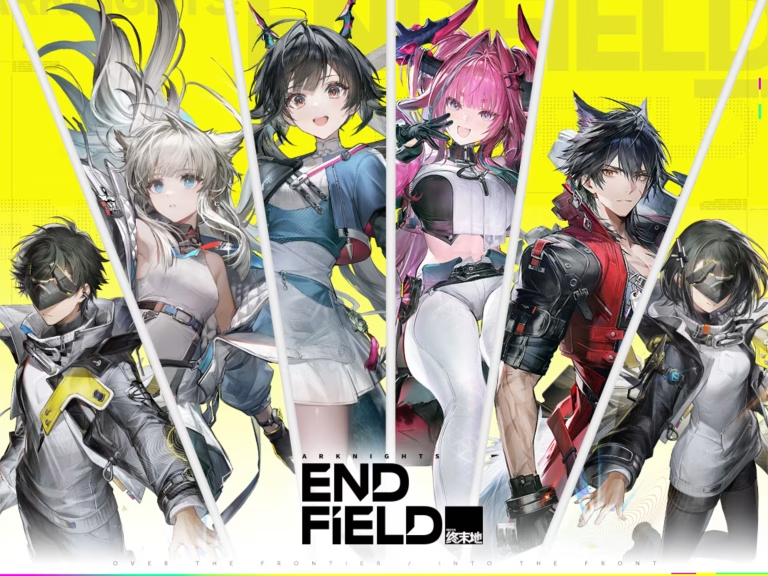
Operators in Endfield are not designed to steal the show constantly.
They feel professional. Restrained. Often guarded.
This makes moments of vulnerability or conflict stand out more when they happen. Characters reveal themselves gradually through interactions and decisions rather than monologues.
It is a quieter style of character writing that fits the setting well.
Where the story seems to be heading
Based on current content, Endfield appears positioned for long term narrative expansion.
Talos II feels like a foundation rather than a complete arc. Political tensions are unresolved. Environmental threats escalate rather than conclude. Systems are introduced with room to grow.
Future updates will likely expand faction conflicts, deepen operator backstories, and introduce new regions rather than wrapping things up neatly.
That slow burn approach suits Endfield’s identity.
Why story matters for long term play
For many players, story determines whether they stay.
Endfield’s narrative does not demand attention, but it rewards it. Players who engage with the world context often find motivation beyond mechanics.
That matters in a game designed for long term progression.
If the world feels meaningful, the grind feels purposeful.
Lore as a design signal
Narrative also signals design philosophy.
Endfield is not aiming for spectacle driven storytelling. It is aiming for coherence.
That suggests future content will likely focus on expanding systems rather than rewriting foundations. New mechanics will probably integrate into existing structures instead of replacing them.
For players invested early, that stability is reassuring.
Connecting story to the bigger picture
Understanding Endfield’s narrative makes other systems clearer. Progression feels intentional. Base building feels justified. Combat pressure feels earned.
For a full breakdown of how story, mechanics, and progression fit together, the Arknights Endfield complete guide ties these elements into a cohesive view of the game.
Seeing the whole structure makes individual systems easier to appreciate.
Final thoughts
Arknights Endfield tells its story the same way it builds its systems. Slowly. Deliberately. With trust in the player.
It does not chase emotional spikes. It builds atmosphere and implication. That approach will not click with everyone, but for players who value depth over spectacle, it gives the game staying power.
If you care about worlds that feel lived in and systems that respect their own logic, Endfield’s narrative is not background noise. It is the framework holding everything together.